Calendar
In the calendar you schedule appointments and see at a glance who is coming and what is still missing.Overview
In the calendar you schedule appointments and see who is coming today. Every appointment is a card in the schedule. The card shows who the patient is, when the appointment is and what its status is.
You choose how the calendar looks, in two places:
- Under Display above the calendar: for what you want to see now, on this device.
- In your calendar settings: for how the calendar opens by default, on every device.
Open the calendar through Calendar in the menu, or with G A.
Choose a view
Above the calendar you choose the view:
- Day: one day, with a column for each selected user.
- 5 Days, Week and 2 Weeks: several days side by side.
- Continuous: scroll sideways through the days, without paging week by week. The day header with week numbers stays at the top.
- Day per week: the same weekday in consecutive weeks.
- Schedule and Appointment proposals.
Previous and next move a day, a week or a range of days. Today, or T, takes you back to today.
In the Day view every user gets their own column. When you select many users, the columns stay wide enough to read and the calendar scrolls sideways.
Read the appointment cards
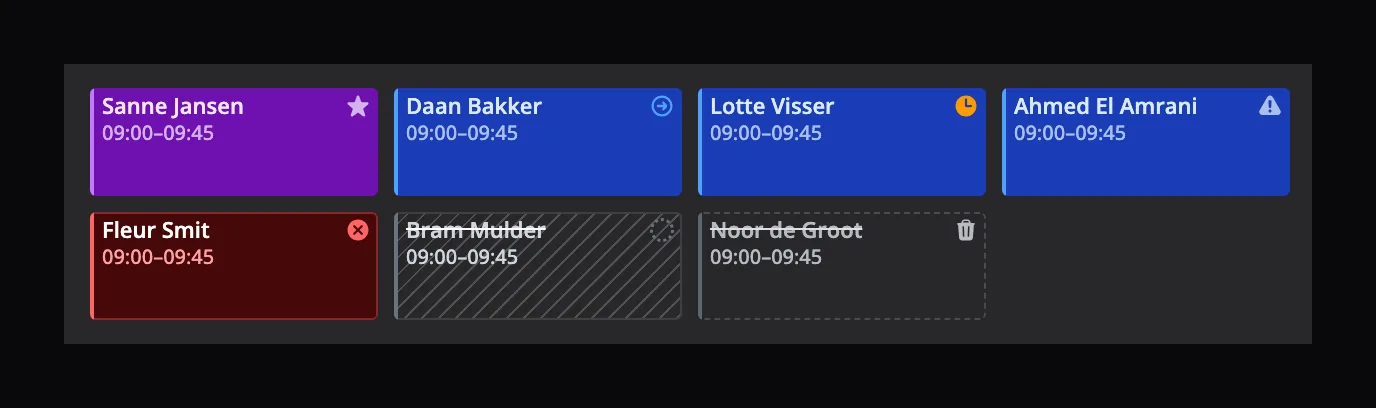
The patient's name sits at the top of the card, with the time below it. A narrow bar on the left shows the appointment's colour. A short appointment fits on a single line.
The status icon shows in the top right once an appointment has moved past Booked:
- Arrived: the patient is here.
- Running late: the patient has let you know they will be late. Set this status when a patient calls to say they are late, and everyone sees it in the calendar.
- Fulfilled: the appointment has taken place.
- No-show: the card is red.
- Cancelled: the card is hatched and the name struck through.
A deleted appointment has a dashed outline and a struck-through name. Deleted, cancelled and no-show appointments only show when you turn them on under Display.
Besides the status, a card can have markers:
- A star: this is the patient's first appointment, so the front desk can give that patient extra attention.
- A warning triangle: something is missing. Hover over the icon to see what, for example No appointment type selected.
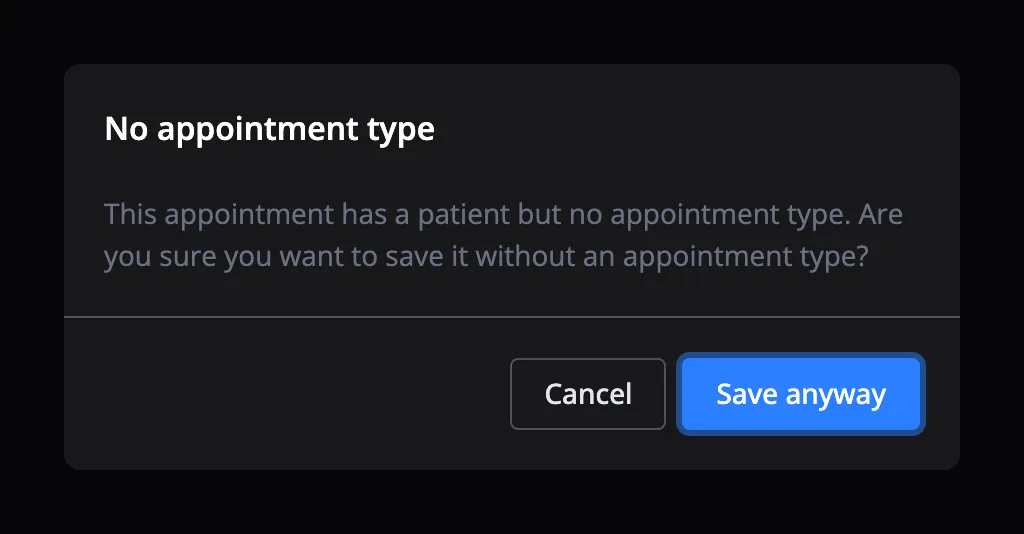
An appointment with a patient but no appointment type is allowed. When you save one, Flux asks if you are sure. Choose 'Save anyway' to go ahead.
In the Week and 2 Weeks views the columns are narrow. The card then keeps the status icon, the time and the markers in view first. The name is left out when there is no room for it.
Collapse the sidebars
To the left of the calendar are the mini calendar and the users. On the right is the side panel with the appointment details, the waitlist and the shortcuts.
- Collapse or expand the left sidebar with the arrow at the left of the header, or with [.
- Collapse or expand the side panel with the arrow at the right of the header, or with ].
These shortcuts don't work while you are typing in a text field.
Collapse both and the calendar fills the whole screen. Flux remembers your choice on this device.
Adjust the display
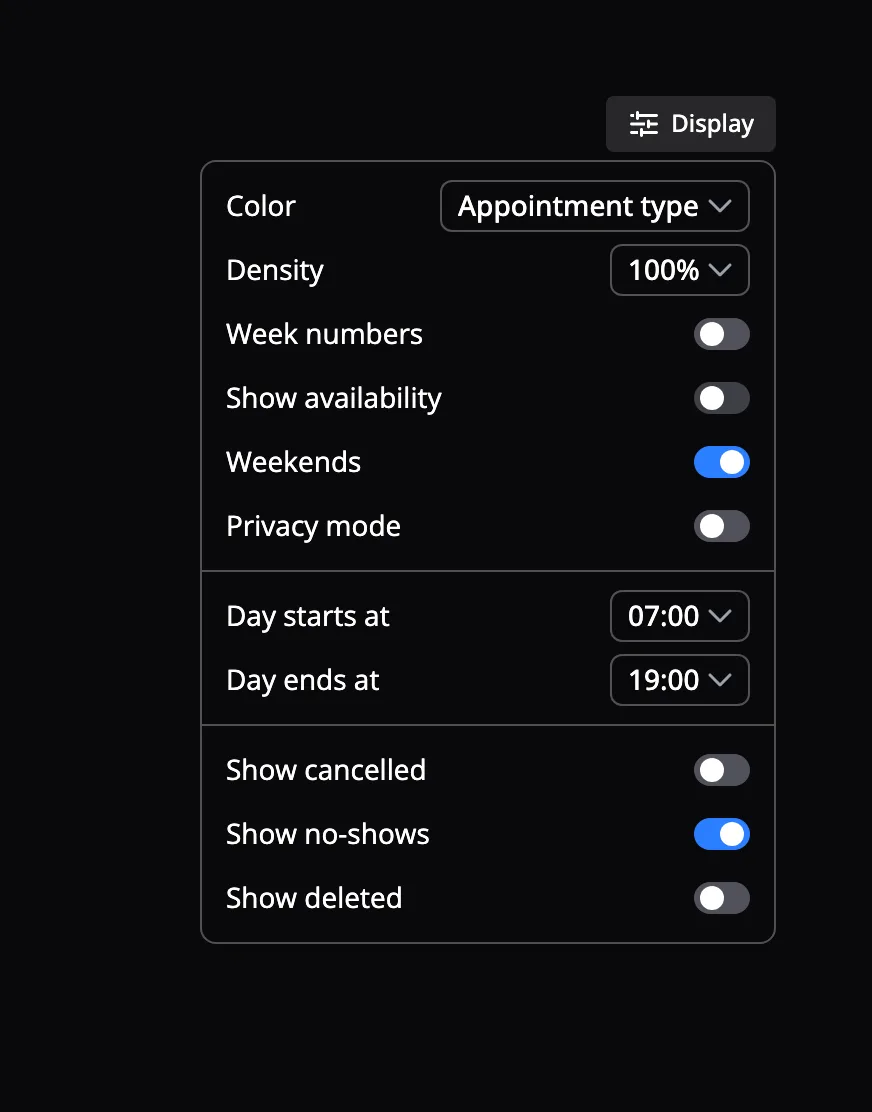
Click Display above the calendar. What you choose here applies on this device.
- Color: colour the cards by appointment type, location or user.
- Density: make the schedule shorter, so more hours fit on screen.
- Week numbers: show the week number with the date.
- Show availability: show the available times and locations above the columns. This works only in the Day view or with one user selected.
- Weekends: show or hide Saturday and Sunday in the Week, 2 Weeks and 5 Days views.
- Privacy mode: hide patient names in the calendar.
- Day starts at and Day ends at: the hours the calendar shows.
- Show cancelled, Show no-shows and Show deleted.
Hide weekends
Turn Weekends off and the calendar shows Monday to Friday only. If a hidden weekend does hold appointments, a narrow column shows how many. Click it to show the weekend until you move to another date.
In the 5 Days view with weekends hidden, you count five working days. Start on a Wednesday and you see Wednesday, Thursday, Friday, Monday and Tuesday.
Privacy mode
When a patient can see your screen, turn on privacy mode. The card then shows the appointment type instead of the patient's name, and hides the birthday, the description and the first-appointment star. An appointment without an appointment type then reads Appointment.
Turn privacy mode on and off under Display or with P.
High contrast
If the lines and edges in the calendar are hard to see, turn on high contrast:
- Go to Settings → User → Display.
- Turn on High contrast and click Save.
Grid lines, off-hours shading, column headers, free slots, appointments, location strips and the current-time line then become easier to see. Only the calendar changes; the sidebars and the rest of Flux stay as they are. The setting applies on this device.
Your calendar settings
Go to Settings → User → Calendar. What you set here decides how the calendar opens, on every device. Among other things:
- Default day view and First day of the week.
- Start on today: the view starts on the day you selected, instead of at the start of its week.
- Weekends and Week numbers.
- Visible hours: the calendar shows only these hours, so you don't scroll past the night. If an appointment falls outside them, the calendar extends so you still see it.
- Grid lines: how often a line is drawn in the calendar, every hour or every 30, 15 or 10 minutes. Lines between whole hours are more subtle.
- User calendar order and Unavailable users.
Week numbers, Weekends and the visible hours can be changed per device under Display. What you choose there wins on that device.
You can find all calendar shortcuts under Shortcuts.